
Safe, Supported and Free: What Real Independence Looks Like

Safety matters in social care. People should be protected from abuse, neglect and avoidable harm, and support should be planned carefully around their individual circumstances.
But safety is not the whole purpose of supported living.

A person can be physically safe while having very little control over where they go, what they do, who they spend time with or how their support is delivered. A life organised entirely around preventing every possible problem may be predictable, but it may not be particularly independent.
The more difficult and important question is:
How do we support someone to be safe without unnecessarily restricting their life?
Independence does not mean doing everything alone
We often talk about independence as though it means being able to complete tasks without help. For people receiving support, that can be a misleading definition.
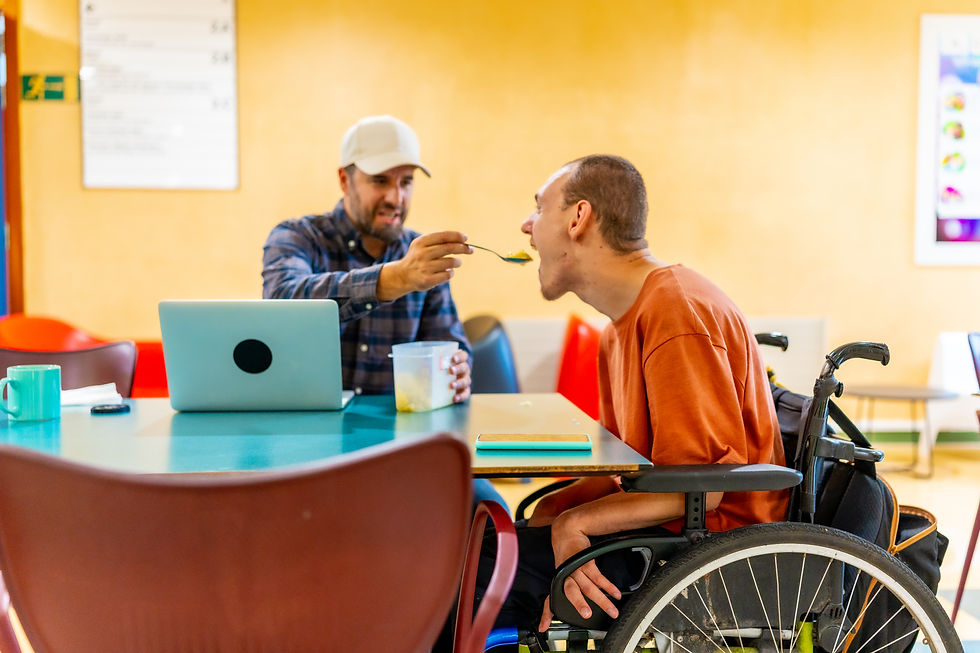
A person may need support with money, medication, communication, travel or household tasks while still exercising meaningful control over their life.
They might choose where they want to go but need help planning the journey. They might decide what to buy but need support to understand a budget. They may communicate a preference through behaviour, facial expression or a familiar routine rather than speech.
The important question is not simply: “Can this person do this unaided?”
A better question is: “What support would enable this person to be involved, exercise choice and do as much as possible for themselves?”
That distinction matters. Independence is not necessarily about removing support. Often, it is about providing support in a way that gives the person greater control.

Safety, choice and the law
This principle is reflected in the legal and regulatory framework around adult social care.
The Care Act 2014 places individual wellbeing at the heart of care and support. Its definition of wellbeing includes dignity, control over day-to-day life, participation in work, education, training or recreation, relationships, suitable accommodation and a person’s contribution to society. It also says people should participate as fully as possible in decisions and that restrictions on their rights or freedom should be kept to the minimum necessary.¹
The accompanying Care and support statutory guidance describes the core purpose of adult care and support as helping people achieve the outcomes that matter to them.²
There is an equally important principle in the Mental Capacity Act 2005. A person must be assumed to have capacity unless it is established otherwise, and they must be given practicable help to make a decision before being treated as unable to do so. Crucially, someone cannot be treated as lacking capacity simply because they make a decision that other people regard as unwise.¹
Where a decision is made on behalf of someone who lacks capacity for that particular decision, the Act requires it to be in their best interests and asks whether the purpose could be achieved in a way that is less restrictive of their rights and freedom.¹
Current Care Quality Commission guidance for services supporting autistic people and people with a learning disability, updated on 5 August 2026, points in the same direction. Its “Right support” principle says that models of care and settings should maximise people’s choice, control and independence. CQC also expects care to be person-centred and to promote dignity, privacy and human rights.³
These are significant principles because they move the conversation beyond simply asking whether somebody is safe.
Good support should consider what kind of life the person is able to lead.
Positive risk-taking is not careless risk-taking
Almost every ordinary life involves risk. People travel, spend money, form relationships, cook, go online, try unfamiliar activities and make decisions that friends or family might not make themselves. Removing every possible risk would inevitably remove a considerable amount of ordinary life too.
That does not mean risks should be ignored. Positive risk-taking is not careless risk-taking.
It means starting with what the person wants to achieve, understanding the genuine risks involved and asking whether those risks can be managed without unnecessarily removing the opportunity.
Useful questions might include:
What does the person want to achieve?
Why does this choice matter to them?
How do they communicate agreement, reluctance, anxiety or enjoyment?
What is the actual risk, rather than the assumed risk?
What support could reduce the likelihood or impact of harm?
Is a proposed restriction genuinely necessary?
Could we achieve the same purpose in a less restrictive way?
These are useful practice questions, not replacements for individual capacity assessments, safeguarding processes or professional risk assessments where those are required.
The principle is simply that risk and opportunity should be considered together.

Good risk management can make things possible
A risk assessment is at its most useful when it helps answer “How could we do this?”, rather than simply producing a reason why something cannot happen.
Imagine somebody wants to travel somewhere unfamiliar. The risks may be genuine. But the choice does not necessarily have to be between travelling completely independently and not going at all. Depending on the individual circumstances, support might involve becoming familiar with the route gradually, travelling at a quieter time, using accessible information, practising one part of the journey or agreeing how the person will communicate if they want to stop. Over time, support might change as confidence and familiarity develop. That is the difference between identifying a risk and automatically allowing that risk to determine the outcome.
NICE guidance on service design and delivery for people with learning disabilities and behaviour that challenges recommends that organisations take joint responsibility for managing risk. It specifically says they should aim to manage risks and difficulties without resorting to changing placements or placing greater restrictions on the person.⁴
The same guidance says support should maximise a person’s control and help them take an active part in the aspects of daily life they choose.⁴
In other words, good risk management should help create opportunities wherever it reasonably can.
Choice has to mean something
This brings us to one of the easiest words in social care to use and one of the hardest to deliver properly: choice.
Offering somebody a choice does not automatically give them meaningful control.
Consider a simple question: “Would you like tea or coffee?”
Technically, that offers a choice. But what if the person actually wants juice? What if they want to make their own drink? What if they want to go to a café? What if they do not want anything at all? If all the options have already been decided by somebody else, the person's control remains limited.
The same can happen on a larger scale. An activity timetable might contain plenty of options while still leaving little opportunity for a person to suggest something completely different.
Meaningful choice requires us to think about:
How information is presented
Whether the person has enough time to respond
Whether communication is accessible
Whether non-verbal responses are recognised
Whether “no” is genuinely accepted
Whether preferences lead to action
Whether choices are revisited as circumstances change
For someone who does not communicate primarily through speech, knowing the person well can be particularly valuable. Familiarity may help staff recognise preferences or subtle changes in communication. But knowing somebody well should never become an excuse to make their choices for them.
NICE recommends actively involving people with a learning disability in decisions that affect them and finding out what they want from their lives, not simply what they want from services.⁴ That is a useful distinction.

Independence looks different for different people
There is no single destination called “independence”. For one person, progress might mean learning to travel independently. For somebody else, it could mean choosing where they want to go while continuing to receive support throughout the journey. It could be preparing part of a meal rather than the whole thing. Choosing how a room is decorated. Managing one part of a budget. Deciding what time to get up. Saying no to an activity. Going somewhere new for the first time. These differences matter because independence should not be judged by comparing one person with another.
Nor should success be measured only by how much paid support has disappeared. A person may still require substantial support while gaining greater confidence, expressing clearer preferences, participating more fully in decisions or having more control over what happens in their day. Those can all represent meaningful changes.
Independence also happens beyond the front door
Supported living is about far more than what happens inside someone's home.
Relationships, work, learning, leisure and participation in the community all form part of ordinary life. The Care Act 2014 specifically includes participation in work, education, training or recreation, relationships and an individual’s contribution to society within its definition of wellbeing.¹
CQC says autistic people and people with a learning disability should have the choices, dignity, independence and access to local communities that other people take for granted.³
But community participation is not simply a question of how many outings appear in somebody’s diary. A regular visit to a familiar place where somebody makes choices, develops confidence and builds relationships may provide more meaningful participation than a packed timetable of places chosen for them. Someone might want to maintain family relationships, become known at a local café, attend a club, use local shops, volunteer, study, work or simply spend time somewhere they enjoy.
The important question is not “How much did we do?”
It is “How much did this matter to the person?”
Safe and free should not be opposites
There will always be difficult decisions in social care. There will be situations where restrictions are necessary to protect somebody from genuine harm. There will also be decisions requiring formal capacity assessment, safeguarding processes, best-interests decision-making or specialist professional advice.
None of this removes the need to keep asking whether the person's voice, rights and desired outcomes remain at the centre of the decision.
Perhaps the most useful question is:
How can we help this person have more control over their own life while managing genuine risks fairly and proportionately?
Sometimes that will mean a boundary or restriction. At other times, it may mean better communication, carefully planned support, a gradual approach, or accepting a reasonable degree of uncertainty. That balance is not always straightforward.
But independence was never supposed to mean doing everything alone.
At its best, supported living provides the help somebody needs without unnecessarily taking over: enabling people to make choices, develop confidence, participate in their communities and live a life that is recognisably their own.
Experience what it feels like to be part of a tribe. A family of like-minded individuals trying to do some good in the world.
Experience what it feels like to have nurturing leaders who genuinely care about you as a person and co-workers who step in and support you when you most need it.
Experience a company where you can make new friends and develop deeper relationships with not only those you support, but those you work alongside too.
Become part of our tribe, hit the ‘Apply Now’ button below.
Website👉🌐 www.3tcs.co.uk
Blog👉📰 https://3tcs.co.uk/blog/
Newsletter Sign Up👉📨 newslettersignup/
_______________
FOLLOW US ON SOCIAL MEDIA👇
Our Facebook Page: https://www.facebook.com/3tcsltd
Our Instagram Channel: https://www.instagram.com/3tcsltd/
Our LinkedIn Page: https://www.linkedin.com/company/3-trees-care-and-support-limited/
Our TikTok Channel: https://www.tiktok.com/@3treescare?_t=8W3Vif0Xrr4&_r=1
Linktree: https://linktr.ee/3tcsmarketing
______________
🎬 ESSENTIAL VIDEOS🎬
Welcome to 3TCS YouTube Channel 👇
Our Social Care Training System (MASTERS) 👇
Our Values 👇
What is Supported Living? 👇
Top 10 Interview Tips for Social Care Workers 👇
1. Care Act 2014, Section 1: Promoting individual wellbeing. Mental Capacity Act 2005, Section 1: The principles, [legislation.gov.uk]
3. Services for autistic people and people with a learning disability: Right support, right care, right culture, CQC, published 17 February 2026 and updated 5 August 2026. [cqc.org.uk]
4. Learning disabilities and behaviour that challenges: service design and delivery, NG93, NICE, published 28 March 2018. [nice.org.uk]

Comments